
A draft version of this was released last Monday. Sorry about that. This is the final version that should have been sent.
Table of Contents
- In Search of Lucio: So, What’s in a (Last) Name? Part 2
- What does it mean that Lucio was “given a name” and How and Why?
- Why was Lucio given the name Valeriano?
- Pizza Review – Leo’s, East Rochester, NY
In Search of Lucio: So, What’s in a (Last) Name? Part 2
In my last post, I reviewed the convoluted path that the last names of my direct male ancestors took to get to Valleriano from Rocco to Valeriano, and some elusive, unknown surname.
This complexity began with my Bisnonno (Great Grandpa, GGP) Lucio’s birth, abandonment, and naming in Solofra, Avellino, Campania in 1871. That last post analyzed some questions regarding Lucio’s birth record (below) including “What is a Routa dei Proietti in the New Street Quarter?” and “What’s this about Infant Abandonment?” as part unraveling the threads of our family history.

This post continues to these questions:
- What does it mean that he was “given the name” and why?
- Why Valeriano?
Andiamo!
What does it mean that Lucio was “given a name” and How and Why?
The naming of abandoned babies is both fascinating and poignant. In the context of baptism, it fell upon town officials to bestow names upon these forsaken infants. These babies names diverged from the existing surnames within the village, hamlet, or neighborhood.
- Protective Measures: The practice of assigning unique last names to abandoned children served a protective purpose. By avoiding existing family names, officials shielded local families from any association with illegitimate offspring.
- Creative or Lazy Officials: Town officials responsible for naming weren’t always imaginative. Many leaned toward simplicity, resulting in millennia-old trends. Babies were often bestowed with the surnames Proietto/Proietti or Esposito, directly signifying their abandonment. Notably, Esposito ranks among the largest Italian-American surnames as a consequence.
- The names Esposito and Proietto carried weighty implications for these children:
- Lack of Protection: If a last name didn’t already exist in the town or was Proietti or Esposito, it signaled the child’s lack of familial protection.
- Hardship and Survival: These abandoned children often toiled in fields from a tender age, enduring hardships that extended beyond mere indentured servitude.
- Emigration and Exploitation: If a fortunate survivor emigrated to America, Brazil, or Argentina with the name Proietti or Esposito, their orphan status was unmistakable. Sadly, exploitation could resume in their new home.
Why was Lucio given the name Valeriano?
Just before Lucio’s birth, a law was enacted (and as with many Italian laws, mostly abided!) to prohibit babies from being named Esposito, Proietti, and similar names that indicate abandonment. This regulation encouraged town officials to exercise more creativity when naming these forsaken infants.
In the document, we see that Diegos Vitale, Solofra’s mayor, and Raffaella Corsaro, Solofra’s Receiver of abandoned babies, were creative and decided to bestow the name “Lucio Valeriano” upon the child.
And following the “Protective Measures” mentioned above, the surname Valeriano does not appear in any local directories for Solofra or Serino, nor is it recognized today as originating in those towns like our Grandmother’s family surnames.
But why Valeriano? Here’s my speculative theory with historical roots:
- Sabine Origins: The genesis of Valerii can be traced to around 1000 BC with the Sabines, who predominantly inhabited the Apennine Mountains (where Avellino is situated).
- Ancient Lineage: The Valerian (Valerii) name traces back to a lineage of ruling-class citizens and military generals in Rome, dating as far back as 500 BC.
- Roman Emperors: Valerian and his grandson, Valerian II, held the title of Roman Emperors during the 200s AD.
- Advocates for the Commoners: The Valerii (Valerian) were known for championing “plebeian causes,” advocating for the poor and commoners rather than the ruling elite.

The above shows that the Valerian name has ancient and significant origins around Avellino. Additionally, Valerian has Roman Empire significance. Finally, Valerian/Valerii, although powerful, were benevolent to the less fortunate (as would be an abandoned baby).
Is it possible that Diegos Vitale and Raffealla Corsaro were tifosi (fans, advocates) of the Valerian and their benevolence? Were they aficionados of Roman and Ancient Italic history? Did those lead to Lucio’s naming?
Resources:
- https://en.wikipedia.org/wiki/Valerian_of_Abbenza
- https://en.wikipedia.org/wiki/Valerian_(emperor)
- https://en.wikipedia.org/wiki/Valerii_(name)
- https://en.wikipedia.org/wiki/Valerius_(name)
- https://en.wikipedia.org/wiki/Valeria_gens
Future posts will explore:
- Why was Lucio’s Wet Nurse So Important?
- Were there/are there others from Lucio’s parents?
- What about Rocco?
- What about Valleriano?
- What’s a foundling and domiciled?
- Are there other Valeriano?
- Who are Lucio’s parents? Mother? Father?
- What’s the REAL last name?
- Why did Lucio survive when most others didn’t? Place or people?
- Why were there several different last names?
Pizza Review – Leo’s, East Rochester, NY
In my previous post about Rubino’s, I voiced my displeasure about Leo’s seemingly straying from its roots with fewer Italian-American specialty items and more Medigan items. We used to go to Leo’s often, but that has waned as their selection of specialty items seems reduced. In fact, just before I typed this, I’d been to Leo’s during a ride with friends for coffee and cannoli!
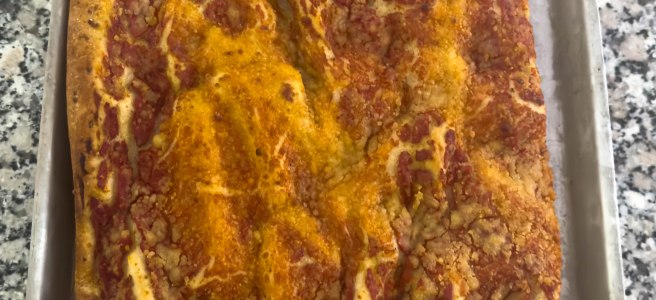
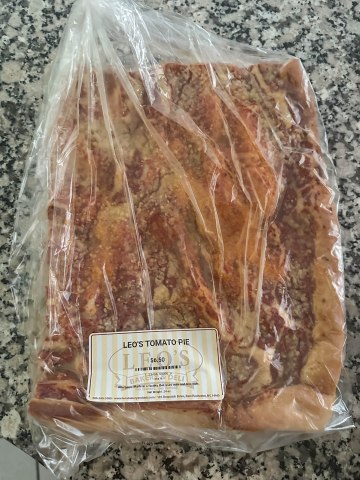
Leo’s always has par baked Sicilian Pizza/Tomato Pie for take-out. I’ve featured Leo’s multiple times in Pizza Reviews. We would not return if Leo’s wasn’t good, but this time it was a little disappointing.
| Date | June 21, 2024 |
| Pizzeria | Leo’s Bakery and Deli |
| City/Neighborhood | East Rochester, NY |
| Website | Leo’s Bakery and Deli | Bakery – Rochester, NY (leosbakeryanddeli.com) |
| About Us | Deli Sandwich Platters, Boar’s Head Meats – Rochester, NY | Leo’s Bakery and Deli (leosbakeryanddeli.com) |
| Style | Sheet – Sicilian, Tomato Pie |
| Ambiance | Take out packed in a loose plastic bag (unlike Rubino’s) |
| Rating Criteria | |
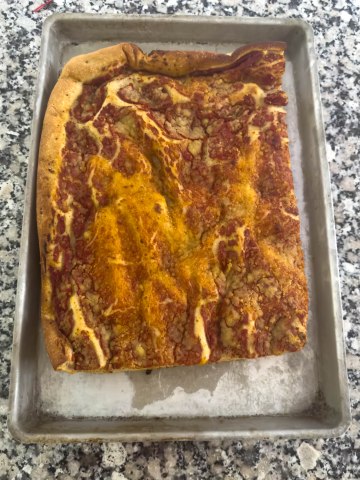
| Shape | Rectangular, 1/4 sheet (a full sheet is 18 x 24) |
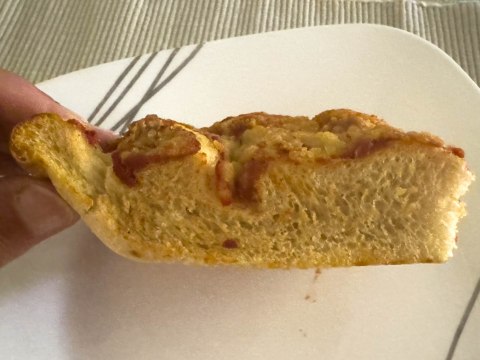
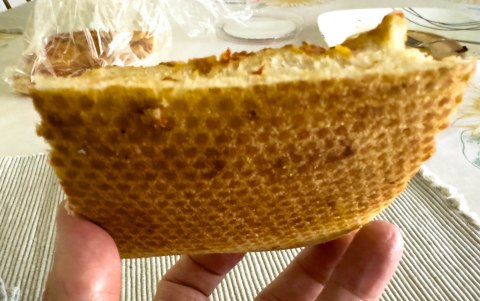
| Dough/Crust | Tickness – very Tick Cook – Soft, slight crispiness due to pan re-baking in home oven, Bread like Flavor – not much, bland |
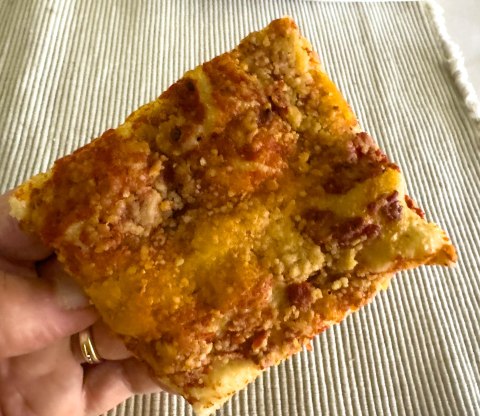
| Cornicione | Spongy/airy, Chewy, Soft, there was almost no distinction between middle and cornicione |
| Toppings | Cheese Fresh – unsure |
| Sauce | Thin Very little, so little that much of the pizza was orange from sauce rub from the back of a spoon |
| Cheese | Cheese Type – – likely parmagian, salty but not very sharp, likely American parmagian versus Parmigiano Reggiano Cheese Distribution – Splotchy, Salty |
| Cheese to Sauce Ratio | Sauce – A little to none Cheese – A little Balanced could use more of both |
| Value | Outstanding!!! $6.50 for a 9″ x 12″ 1/4 sheet which is $6.80 for a 12″ equivalent round, likely the best price that I’ve found anywhere in North America |
| Overall Rating | Meh! After many other good Tomato Pies at Leo’s, this was a clunker. Just no sauce. Even with such a great price, I can’t give it a good. |
| Would I Go Back? | Yes, already have! |


You must be logged in to post a comment.