
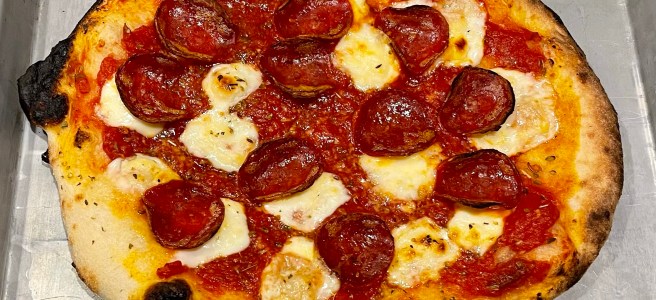
A definition and quick story first. Then below is further info on Caputo Blue vs Caputo Red flours, some insight from the professional pizziola, and next bake in the Ooni Karu 12.
As promised, here are updated tables at the links below:
1. Great Pizza Search – Homemade Pizzas (217 made in 2022)
2. Great Pizza Search – Homemade Doughs
3. Great Pizza Search – Purchased Pizzas (79 purchases in last 3 years, 46 in 2022)
Neapolitan Word of the Day
Pesce – pronounced p-ay-shay. Meaning fish. Plural – Pesci pronounced p-ay-she.
Dad’s (Grandpa Tony) bowling friend with the last name of Fish had the nickname of Pesce. I’m not sure if he “Americanized” his name Pesce/Pesci to Fish. Name Americanization was nearly required back then to get some jobs (as were requirements to learn English). To me, Americanization is intolerable; so where are all the protesters for Southern Italian Immigrants?
As a matter of fact, Ma’s (Grandma Joanne) adoptive father had the nickname of Big Pesc (#126 on this list – see link). Presumably Big Pesc (Big Fish) was as a result of his position (as a pedrone on the docks and railroad)? That’s MY guess, but I’ll never be sure, but that’s how things went back then.
Finally, there’s actor Joe Pesci (see link) which is his real name, no Americanization needed.
La Festa dei Sette Pesci
The Feast of the 7 Fishes is not an Italian tradition! What?!
The Feast of the 7 Fishes originated in the US as a Christmas Eve, Southern Italian-American tradition (see link). Most (all?) “Italian” traditions in the US originated with Southern Italians!
If you don’t believe me, just walk the streets of Napoli and ask “Quando è la Festa dei Sette Pesci (When is the Feast of the Seven Fishes)?” The look will be quizzical unless they have US relatives!
As a kid, I looked at Christmas with cautious exuberance; excited that Christmas morning was coming, not so much about Christmas Eve dinner and midnight mass.
For Christmas Eve dinner, we went Grandma Rocco’s (aka Grandma Flo), my father’s mother for the Feast of Many Fishes; I’ve never been sure there really was 7. I never was in the mood to count. It seemed like millions of different smelly, big and little, fishy looking things to this non-fish eater (although, I’m trying, again…baby steps….!).
The eel was the dish that most disgusted me; the look, not the taste. I’d be hard pressed to ever taste one…maybe if I were on Naked and Afraid (I’m certain my partner would be more Afraid because I was Naked!) I might be pressed enough to partake!
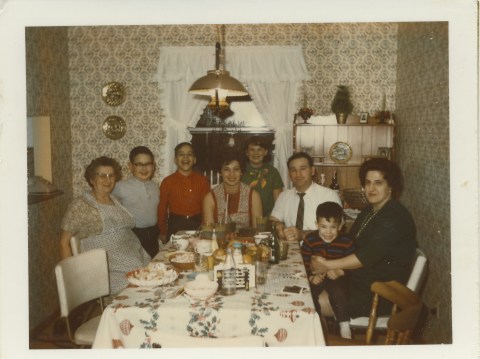
Because of my disfinity (is that the opposite for affinity?) for fish, Grandma would make some spaghetti and sauce, but it was not as good as my Ma’s (Grandma Joanne) but I’d force it down. Grandma Rocco’s sauce always seemed to taste fishy. I always wondered if some of the fish soaked in her sauce while cooking because there always was a sauce covered fish dish as one of the fishes. Although, everyone denied it for Grandma.
What I truly enjoyed were the roasted chestnuts. We didn’t have chestnuts at any other time of the year, and I’m unsure why. Grandma Rocco was born in Serino, Campania, Italy about 5 miles from Avellino and 25 miles up in the mountains above Napoli. The rough, rocky terrain around Avellino is not suited to growing much, although chestnuts and wine grape flourish. I’m guessing that’s why we had roasted chestnuts along with the Feast.
I might have disliked Midnight Mass more then 7 Fishes as a kid, but I’ll explore that in the next post.
Caputo Blue vs Caputo Red
In my previous post, I said that I’d purchased a Ooni Karu 12 and am happy except for the pizza to pizza crust variability. This variability is likely due to my flour choice, my dough recipe, my inability to keep the wood fired oven temp consistent, and FL vs NY environmental differences, and other variables.
The 3 bakes (21 pizzas) with my Ooni Karu 12 have been with Caputo Blue (aka Pizzeria Flour). I found a good deal for Blue on Amazon and bought 4kg/10lbs. (4 bakes of 6 pizzas worth). Blue was recommended by our Pizzaiolo from pizza school in Sorrento, Campania, Italy.
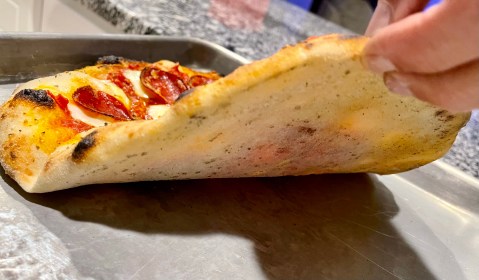
Blue tastes great, but it works differently than Caputo Red (aka Caputo Chef’s flour) for me which I’ve primarily used to now. The Blue does not easily work into rounds like Red with my “normal” dough recipe. I stretch the Blue into 10” rounds, and it immediately shrinks back to 8” no matter what stretching technique I utilize. Whereas, my Red dough rounds stretch to 10+” and stay that way.
Some Research on Caputo Flours
I’ve spent lots on time on YouTube and Google looking for explanations. I found these articles on the Pizza Heaven (see link) and Serious Eats “The Pizza Lab” (see link). I’m still searching for more analytic, scientific explanations.
It seems that Blue is better for shorter fermentation times of less than 24 hours and hotter temperatures of wood fired ovens. Conversely, I typically use longer 24 – 72 hours of slow, refrigerated cool ferment.
Conversely, Caputo Red, even though it’s better for my long and cold ferment style of dough making, is supposed to be better in lower temp ovens like that of a home oven versus my high temp wood fired Ooni.
So, this information is confounding at best. What’s an engineer to do? Experiment! And, ask more questions!
The Experiment – More Water
After the research, I plan to:
1. change my recipe to add more water
2. be more diligent about my record keeping of environmental factors
My current recipe uses 60% hydration; 6 parts water by weight to 10 parts flour. Therefore, 600 grams of water per 1000 grams (1kg bag) of flour. This (with salt and yeast) yields 6 x 265 gram dough balls perfect for 6 x 10+” pizza rounds.
If you’ve read the articles linked above, you’ll realize that adding more water, well, doesn’t necessary hold water! The articles show that the primary difference between Blue and Red is the amount of gluten with Blue having less gluten, therefore, there should be less gluten bonds and a more pliable dough with Blue even without the additional water.
Though it’s confounding, I plan to add 10% more water (660 grams, 66% hydration). My postulate is that the extra water will weaken the gluten bonds and improve “stretch-ability”.
The Experiment – Environmental Differences
Since I don’t need higher hydration in NY, the above hydration change to my dough recipe I’m guessing is needed to account for either differences in flour (Blue in FL, Red in NY) and/or environment. Frankly it’s a guess.
As a result, I plan to track temperatures throughout the dough making process better. There’s an Engineering Explanation farther below (read only if you’re bored)!
The Questioning – Ask an Expert
Back in late August, I biked from Pittsburgh to Cleveland. Our first stop was Mercurio‘s Pizzeria in the Pittsburgh. I wrote ” MERCURIO’S IS THE BEST NEAPOLTAN STYLE PIZZA THAT I’VE EATEN IN NORTH AMERICA….THERE IS SOMETHING SPECIAL GOING ON WITH THEIR DOUGH THAT CAUSES A UNIQUE FLAVOR PROFILE (that post is here see link)
The Mercurio’s owners are related to us by marriage. Luckily for me, I talked at length with Anna C. at a family event this past weekend. She openly shared her dough recipe ingredients, percentages, and timing with me and even said that I could share that recipe!
I don’t feel that I have the right to share details, but here are some tidbits:
1. 66% hydration is closer to Mercurio’s recipe which further makes my decision above feel good
2. They use two different Caputo flours, but after some investigation, both flours are commercial products only available in 25kg (50 pound bags). Neither flour is Red or Blue!!!!!
3. Real, fresh yeast is used, not dry yeast
4. Sea Salt
5. A longish, warm pre-ferment followed by a cold ferment of more than a day
As mentioned above, it’s the best dough that I’ve tasted in North America! So, if I can find the flour, I will copy. BUT, I JUST FOUND FRESH YEAST LOCALLY. CAN’T WAIT TO TRY!
I DID TRY THE 66% HYDRATION. I’M VERY HAPPY – DETAILS, NEXT POST!

What to Read if You’re Bored – Engineering Definitions of Temperature
The differences are in both dry bulb and wet bulb temperatures between NY and FL. Dry and Wet Bulb are engineering terms for what humans call temperature (dry bulb) and dew point (wet bulb). Although, most humans also use humidity instead of dew point. Humidity is actually “relative” humidity. Humidity alone has little information because it’s wet bulb temperature relative to the dry bulb temperature. Wet bulb/dew point are more descriptive of the situation. On the most “humid” days in NY in summer might compare to a “low humidity” day in FL, but in fact, the wet bulb/dew point could be same.
Since I’ve not tracked dry and wet bulb temperatures in my dough making to this point, I will begin to track them at the time of mixing the dough, while in the frig, after frig removal, then at baking. I’m hoping that with some analysis, some nuggets will appear. To paraphrase Tim “The Toolman Taylor, “I need to buy more equipment…Uh, Uh, Uh” to measure temperatures!


You must be logged in to post a comment.